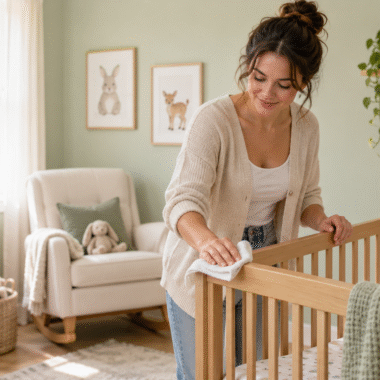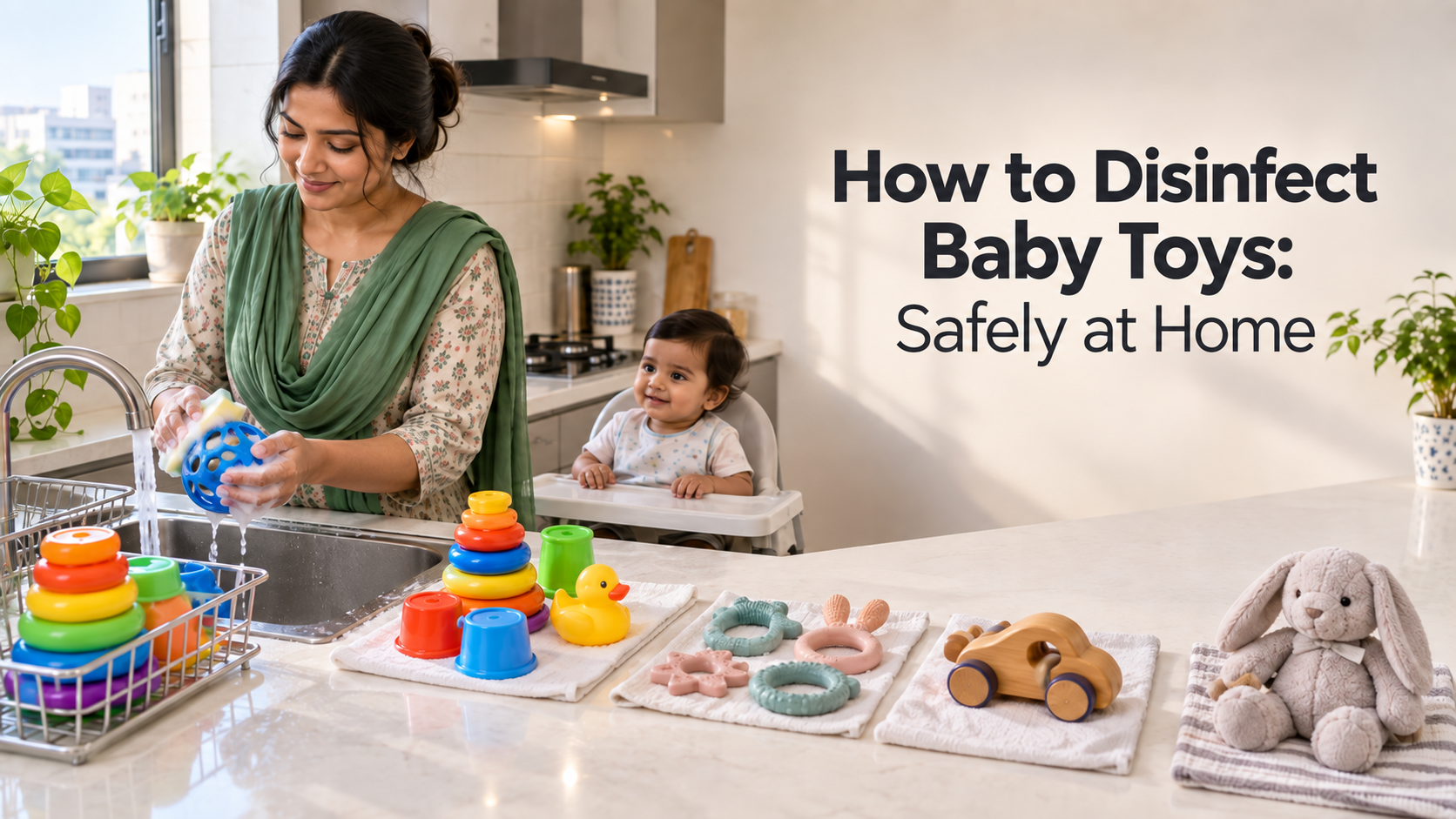
When a baby drops a teether on the floor, chews the same toy repeatedly, or shares toys with another child, it is natural to wonder whether a quick rinse is enough. The challenge is that baby toys are made from very different materials, and a cleaning method that works for hard plastic may damage wood, fabric, batteries, or electronic parts.
A common concern is how much disinfecting is actually necessary. Strong chemicals are not automatically better. In many everyday situations, careful cleaning with soap and water removes most germs, while sanitizing or disinfecting becomes more useful for mouthed toys, shared toys, or after someone in the household has been sick.
This guide explains how to disinfect baby toys safely, how cleaning differs from sanitizing and disinfecting, and what methods work for plastic, silicone, wood, electronic, plush, and mouth-contact toys. It also covers bleach safety, vinegar, drying, common mistakes, and when stronger disinfection is actually warranted.
How to Disinfect Baby Toys Safely: The Basic Method
The safest general approach is to clean the toy first, then sanitize or disinfect it only when appropriate for the material and situation. Start by removing visible dirt with soap or detergent and water. Next, use a manufacturer-approved sanitizing or disinfecting method, respect the required contact time, and allow the toy to dry completely before returning it to your baby.
Cleaning first matters because dirt, saliva, food residue, and other material can interfere with a disinfectant’s ability to work properly. Both the CDC and Ottawa Public Health recommend cleaning toys before applying a sanitizer or disinfectant.
1. Check the Toy Before Cleaning
Look for the manufacturer’s washing instructions first. Pay particular attention to:
- Whether the toy can be submerged
- Whether it is dishwasher-safe
- Whether it contains batteries or electronics
- Whether fabric parts are machine-washable
- Whether heat could deform the material
- Whether paint, glued parts, or wooden sections could be damaged by water
If a toy is cracked, peeling, badly damaged, or trapping moisture where it cannot dry properly, cleaning alone may not make it suitable for continued use.
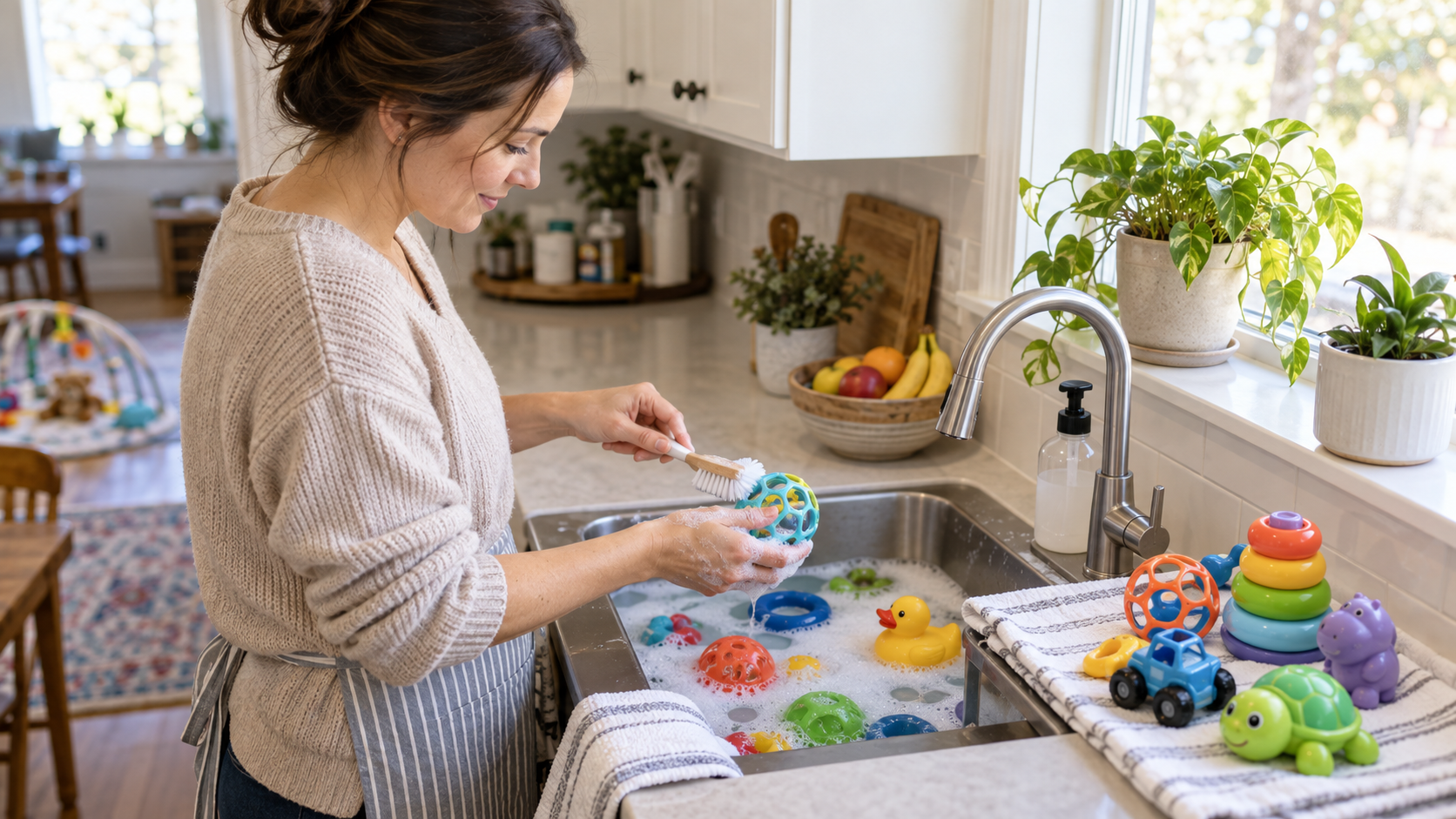
2. Wash Away Dirt, Food, and Saliva
Use warm water and mild soap on washable surfaces. Scrub grooves, textured areas, and other places where residue collects.
Rinse away the soap before using a separate disinfectant. Ottawa Public Health specifically advises rinsing soap residue from hard toys because some cleaning products can interfere with disinfectants.
3. Decide Whether You Need to Sanitize or Disinfect
These terms are not interchangeable.
The CDC defines cleaning as removing dirt and germs with soap, water, and scrubbing. Sanitizing lowers the number of germs to safer levels and is commonly appropriate for objects that contact children’s mouths. Disinfecting uses stronger chemical action to kill remaining germs and is especially relevant when someone is sick or when contamination presents a higher infection risk.
For routine home care, stronger disinfection is not necessary every time a baby touches a toy. The CDC says careful cleaning is sufficient in many everyday household situations.
4. Keep the Surface Wet for the Required Contact Time
A disinfectant does not necessarily work the moment it touches a surface. Many products need the surface to remain visibly wet for a specified amount of time.
Read the product label and follow its contact-time instructions. Do not wipe the product away early simply because the surface looks clean.
5. Rinse When Required and Dry Completely
Follow the disinfectant label for rinsing instructions. Toys that babies put in their mouths deserve particular care. CDC infection-control guidance recommends rinsing mouthed toys after disinfection or using a dishwasher where appropriate.
Finally, allow the toy to dry completely before storing it or giving it back to your baby. Damp storage can create a new hygiene problem even after careful cleaning.
Cleaning vs. Sanitizing vs. Disinfecting Baby Toys
Parents often use these three words to describe the same task, but the distinction helps you avoid unnecessary chemical use.
| Method | What It Does | When It Makes Sense |
|---|---|---|
| Cleaning | Removes dirt, saliva, food and many germs | Routine toy care |
| Sanitizing | Reduces germs to safer levels | Mouthed toys and frequently handled baby items |
| Disinfecting | Kills remaining germs with stronger products | After illness or higher-risk contamination |
The CDC recommends cleaning before either sanitizing or disinfecting. It also notes that disinfecting the home is usually unnecessary unless someone is sick or someone who was sick recently visited.
That means the goal should not be to chemically disinfect every toy after every play session. Match the cleaning level to the actual situation.
When Do Baby Toys Actually Need Disinfecting?
A toy does not automatically require strong disinfection simply because it touched the floor.
Consider sanitizing or disinfecting more carefully when:
- A sick child has played with the toy
- The toy was shared among several children
- Vomit, stool, blood, or other body fluids contaminated it
- A baby repeatedly mouths the toy
- The toy has been handled with visibly dirty or food-covered hands
- Public-health guidance recommends additional cleaning during an infectious illness outbreak
CDC guidance recommends stronger disinfection when someone is sick or at increased risk of illness. Toys that contact children’s mouths are commonly treated as items that may need sanitizing.
For normal daily play at home, regular cleaning may be sufficient.
Choose the Cleaning Method by Toy Material
Before deciding how to disinfect baby toys, identify what the toy is made from and whether it contains parts that cannot get wet.
| Toy Type | Practical Cleaning Approach | Main Caution |
|---|---|---|
| Hard plastic | Soap and water, dishwasher if approved | Check heat resistance |
| Silicone | Soap and water, heat sanitizing if approved | Confirm manufacturer instructions |
| Wood | Damp-cloth cleaning | Do not soak porous wood |
| Electronic toys | Damp cloth or approved wipe | Keep moisture away from openings |
| Plush toys | Machine wash when care label allows | Dry completely |
| Mouthed toys | Wash, then sanitize with an approved method | Check material and rinse instructions |
No single method is right for every toy. Heat-safe plastic may tolerate a sanitizing dishwasher cycle, while unfinished wood or a battery-powered toy requires a much gentler approach.
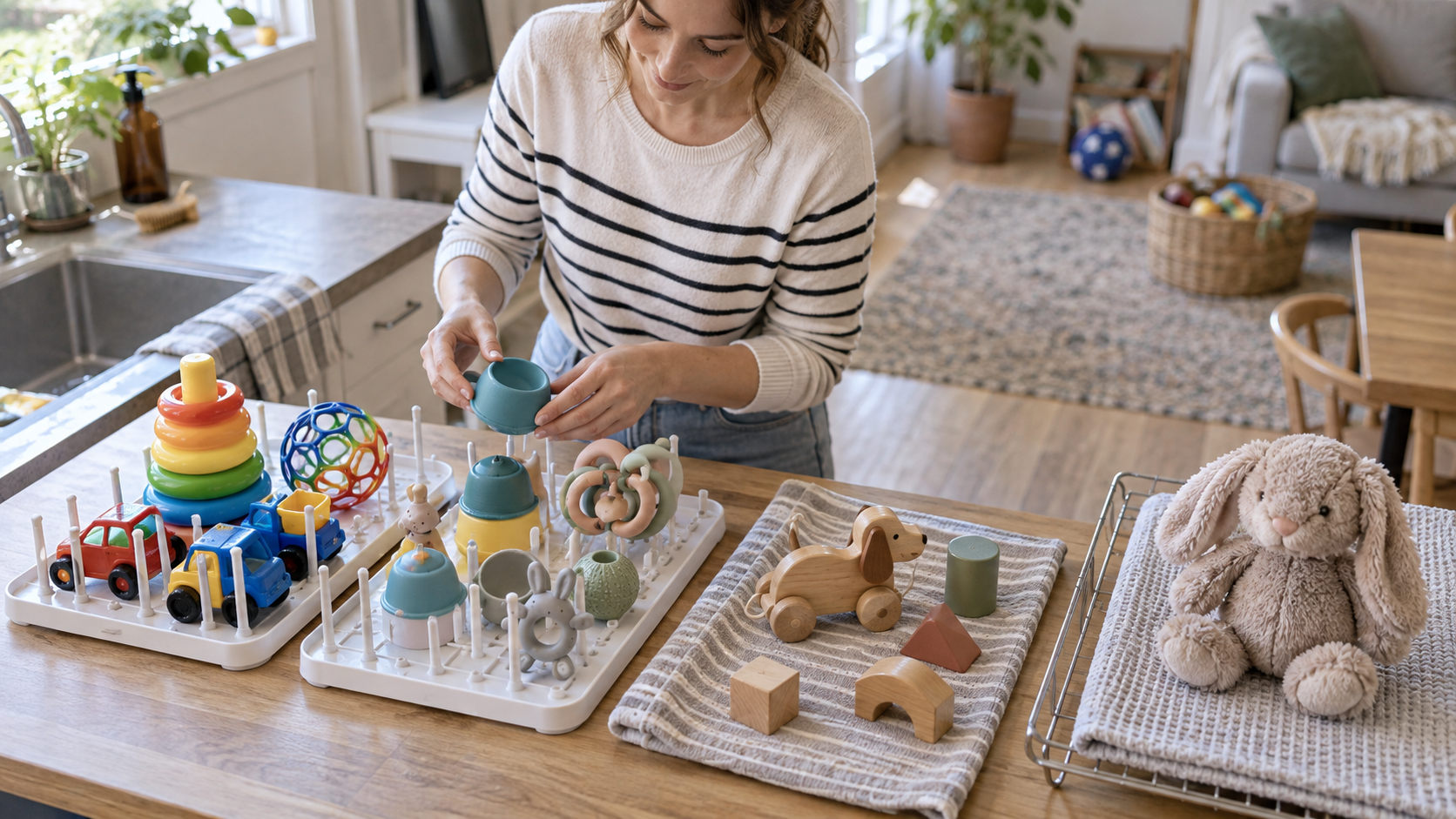
How to Clean and Disinfect Hard Plastic and Silicone Toys
Hard, nonporous toys are generally the easiest baby toys to clean thoroughly.
Start with warm soapy water. Use a clean brush or cloth for seams and grooves, then rinse thoroughly.
For toys specifically identified by the manufacturer as dishwasher-safe, a dishwasher with a sanitizing cycle can be an effective option. The CDC lists dishwasher sanitizing as an appropriate method for certain nonporous toys, and Consumer Reports recommends using the top rack for suitable plastic toys.
Do not assume every silicone or plastic toy can tolerate a dishwasher. Toys containing glue, printed decoration, water-filled sections, electronic components, or heat-sensitive parts may require hand cleaning.
If you use a chemical sanitizer or disinfectant, make sure the product is suitable for that surface and follow its label exactly.
How to Clean Wooden Baby Toys
Wood needs a different approach because it is porous and may absorb water.
Instead of soaking a wooden toy:
- Dip a clean cloth in mild soapy water.
- Wring the cloth out thoroughly.
- Wipe the toy’s surface.
- Use a second damp cloth if needed to remove residue.
- Leave the toy in a well-ventilated area until completely dry.
Consumer Reports advises avoiding prolonged soaking and emphasizes thorough drying. Its experts suggest allowing wooden toys to air-dry for at least 24 hours after cleaning.
Be especially cautious with painted, sealed, glued, or unfinished wooden toys. Always follow the maker’s instructions before applying a disinfecting product because some chemicals or excess moisture can damage the finish.
How to Clean Electronic and Battery-Powered Toys
Electronic toys should generally not be submerged or placed in a dishwasher.
Turn the toy off and remove the batteries when the design allows. Use a slightly damp cloth with mild soapy water to clean the exterior while keeping moisture away from battery compartments, speakers, charging ports, switches, and seams.
If stronger disinfection is needed, use a disinfecting wipe or another product only if both the disinfectant label and the toy manufacturer’s instructions permit it. CDC guidance for electronics similarly recommends following the equipment manufacturer’s directions and observing the disinfectant’s required contact time.
Let the toy dry completely before reinstalling batteries or switching it on.
How to Wash Plush and Stuffed Baby Toys
Check the care label first. Many soft toys can be machine-washed, but toys containing electronic parts, glued decorations, delicate fillings, or non-washable internal components need another method.
For machine-washable plush toys:
- Place delicate toys in a mesh laundry bag or pillowcase if needed.
- Use the warmest water setting permitted by the care label.
- Choose an appropriate detergent.
- Dry the toy completely before returning it to your baby.
CDC guidance recommends laundering washable soft toys according to manufacturer instructions using the warmest appropriate water setting and drying them completely. Ottawa Public Health also recommends machine washing fabric or plush toys and drying suitable items thoroughly.
For plush toys with electronic components, spot-clean only if that is what the manufacturer recommends. Avoid saturating areas containing speakers, batteries, or wiring.
How to Clean Teethers and Toys Babies Put in Their Mouths
Mouth-contact toys deserve more frequent attention because saliva is continually transferred to their surfaces.
Begin by washing the toy thoroughly. Depending on the manufacturer’s directions, suitable nonporous teethers or toys may then be sanitized by:
- A sanitizing dishwasher cycle
- Boiling or steaming when specifically allowed
- A weakened bleach sanitizing solution
- Another sanitizer labeled for that type of item
The CDC recommends sanitizing items and surfaces that infants or young children may put in their mouths. For nonporous items, it lists heat, a weakened bleach solution, and sanitizing dishwasher cycles as possible methods when the item’s manufacturer permits them.
Never boil or steam a teether simply because it looks heat-resistant. Some materials, water-filled teethers, and bonded parts can be damaged by high temperatures.
Using Bleach Safely on Baby Toys
Bleach can sanitize or disinfect appropriate hard, nonporous surfaces, but concentration matters.
For routine sanitizing of suitable nonporous child-use items, CDC early-care guidance gives a weakened solution of:
- 1 tablespoon of regular unscented bleach per 1 gallon of water
- Completely immerse suitable items
- Soak for at least 2 minutes
- Remove with clean hands or tongs
- Allow to air-dry
This recommendation applies to regular unscented bleach and appropriate nonporous items. Always check the toy manufacturer’s instructions first.
For stronger surface disinfection, particularly after illness, CDC household guidance says to follow the bleach bottle’s dilution directions. If suitable directions are unavailable and the bleach contains 5% to 9% sodium hypochlorite, CDC gives a general household-disinfection mixture of 5 tablespoons, or 1/3 cup, of bleach per gallon of room-temperature water. It recommends at least one minute of wet contact time when other instructions are unavailable.
That stronger formula should not automatically become your everyday baby-toy cleaning mixture.
Also follow these rules:
- Use regular unscented bleach with an appropriate sodium hypochlorite concentration.
- Do not use an unsuitable splashless or laundry bleach product for disinfection.
- Provide good ventilation.
- Wear protective equipment when directed.
- Keep bleach and mixed solutions away from babies and children.
- Never mix bleach with another cleaner or disinfectant.
- Prepare diluted bleach according to current label or public-health instructions.
- Follow any rinsing requirements for objects that babies put in their mouths.
EPA warns that disinfectants must be kept away from children and should be used strictly according to their labels. Children should not apply disinfectants themselves.
Can You Use Vinegar to Disinfect Baby Toys?
Vinegar can be useful for cleaning some toys when the material manufacturer allows it, but it should not be treated as a reliable substitute for a registered disinfectant.
CDC infection-control guidance notes that vinegar is not an EPA-registered disinfectant and does not perform reliably against every type of microorganism. Consumer Reports similarly distinguishes vinegar-based toy cleaning from true sanitizing or disinfecting.
So, if you are simply wiping dirt from a compatible wooden or electronic toy, a diluted vinegar cleaning solution may be an option. If you specifically need to disinfect after illness, use a disinfectant that is labeled for the surface and situation.
Never combine vinegar with bleach.
Problem-Solution Guide for Common Baby-Toy Cleaning Problems
Problem: The toy is covered with food, saliva, or sticky residue.
Helpful approach: Wash it with warm soapy water before doing anything else. A disinfectant should not be applied as a substitute for removing visible dirt.
Problem: A sick child has been playing with the toy.
Helpful approach: Clean first, then use a surface-compatible disinfectant or approved bleach solution according to its label. Pay particular attention to contact time.
Problem: The toy cannot be submerged.
Helpful approach: Use a damp cloth to clean the exterior. If disinfection is required, use an appropriate wipe or product that the manufacturer allows rather than soaking the toy.
Problem: The plush toy contains a music box or electronic component.
Helpful approach: Do not place it in a washing machine unless its care instructions explicitly permit that. Spot-clean the fabric and keep liquid away from the electronic section.
Problem: A baby repeatedly puts the toy in their mouth.
Helpful approach: Wash the toy regularly and use an appropriate sanitizing method when needed. Choose methods approved for mouth-contact items and the toy’s material.
Problem: You cannot determine whether a disinfectant is safe for the toy.
Helpful approach: Do not guess. Use basic cleaning until you can check the toy manufacturer’s instructions and the disinfectant label.
How Often Should You Clean Baby Toys?
There is no universal schedule that requires every household toy to be disinfected every day.
Clean toys when they are visibly dirty, sticky, dropped onto dirty surfaces, or repeatedly mouthed. Shared toys may need more frequent attention.
Use stronger sanitizing or disinfecting when the situation justifies it, especially after illness or contamination. The CDC states that in most household situations, cleaning with soap and water removes most germs and routine disinfection is generally unnecessary unless someone is sick or recently visited while sick.
A practical routine is therefore based on how the toy is used, rather than disinfecting every toy on the same schedule.
Mistakes to Avoid When Disinfecting Baby Toys
Disinfecting a Dirty Toy Without Washing It First
Visible grime can interfere with disinfectants. Remove dirt and residue before sanitizing or disinfecting.
Mixing Cleaning Products
Never mix bleach with vinegar, ammonia, another disinfectant, or another cleaner unless a product label specifically says the combination is safe.
CDC warns that mixing bleach with other cleaning products can release dangerous vapors.
Treating Vinegar as a Universal Disinfectant
Vinegar may help clean some surfaces, but it is not a dependable replacement for an approved disinfectant when true disinfection is needed.
Ignoring Contact Time
Do not spray or wipe a disinfectant on a toy and immediately remove it unless the label specifically directs you to. The surface may need to stay wet for a set time.
Soaking Wooden or Electronic Toys
Too much moisture can damage wood, batteries, speakers, wiring, adhesives, and other internal components. Use damp-cloth methods instead.
Assuming Every Plastic Toy Is Dishwasher-Safe
Heat can warp some toys or damage attached components. Check the manufacturer’s directions before placing anything in a dishwasher.
Putting Damp Toys Back Into Storage
Dry toys completely before putting them into a toy box, bag, basket, or cabinet. Moisture trapped in enclosed spaces can create additional hygiene problems.
Letting Children Handle Disinfectants
Keep disinfectants and cleaning solutions out of children’s reach. EPA advises that children should not apply disinfectant products, including disinfecting wipes.
Conclusion
Knowing how to disinfect baby toys safely is mostly about choosing the right level of cleaning for the situation and matching the method to the toy’s material. Start with soap and water because cleaning removes dirt and many germs. For mouth-contact toys, an appropriate sanitizing method may be useful, while stronger disinfection is most relevant after illness or higher-risk contamination.
Hard plastic and suitable silicone toys can often tolerate the most thorough cleaning methods. Wood and electronics need minimal moisture, while plush toys should be washed according to their care labels and dried completely. If bleach or another disinfectant is needed, follow current label directions, observe the required contact time, never mix cleaning chemicals, and keep all products away from children.
The safest choice is not the strongest chemical. It is the cleaning method that is effective for the situation, compatible with the toy, and used exactly as directed.
How to Disinfect Baby Toys Related Questions
Can I use disinfectant wipes on baby toys?
Yes, but only when the wipe is labeled for the toy’s surface and you follow all directions, including contact time and any required rinsing. For toys that go into a baby’s mouth, be especially careful about residue. CDC guidance also recommends following manufacturer instructions when disinfecting electronic items with wipes.
How do I disinfect baby toys after a cold or stomach bug?
Clean the toys first with soap and water, then disinfect suitable hard surfaces with a product approved for that material. Follow the disinfectant’s wet contact time and rinsing instructions. Wash suitable plush toys according to their care labels and dry them completely. Stronger disinfection is particularly appropriate when someone has been ill.
Can I disinfect baby toys with boiling water?
Some nonporous baby items can be sanitized by boiling or steaming, but only when the manufacturer says the item can tolerate heat. CDC guidance lists boiling and steaming as options for certain nonporous child-use objects. Do not boil electronic toys, wooden toys, heat-sensitive plastics, or items whose instructions prohibit it.
Is dish soap enough to clean baby toys?
For many routine situations, yes. Soap, water, and scrubbing remove dirt and many harmful germs, and CDC guidance says cleaning alone is often sufficient in homes when nobody is sick. Sanitizing or disinfecting becomes more relevant for mouthed toys, shared items, illness, or higher-risk contamination.
Should baby toys be disinfected every day?
Usually not in a typical home. Cleaning frequency should depend on how the toy is used, whether it is visibly dirty, whether a baby mouths it, whether it is shared, and whether someone has been sick. CDC guidance indicates that routine household disinfection is generally unnecessary when there is no illness concern.
Can vinegar disinfect baby toys naturally?
Vinegar can clean some compatible toys, but it should not be relied on as a universal disinfectant. CDC guidance notes that vinegar is not an EPA-registered disinfectant and is not reliably effective against every organism. When true disinfection is needed, use an appropriate registered product according to its label.