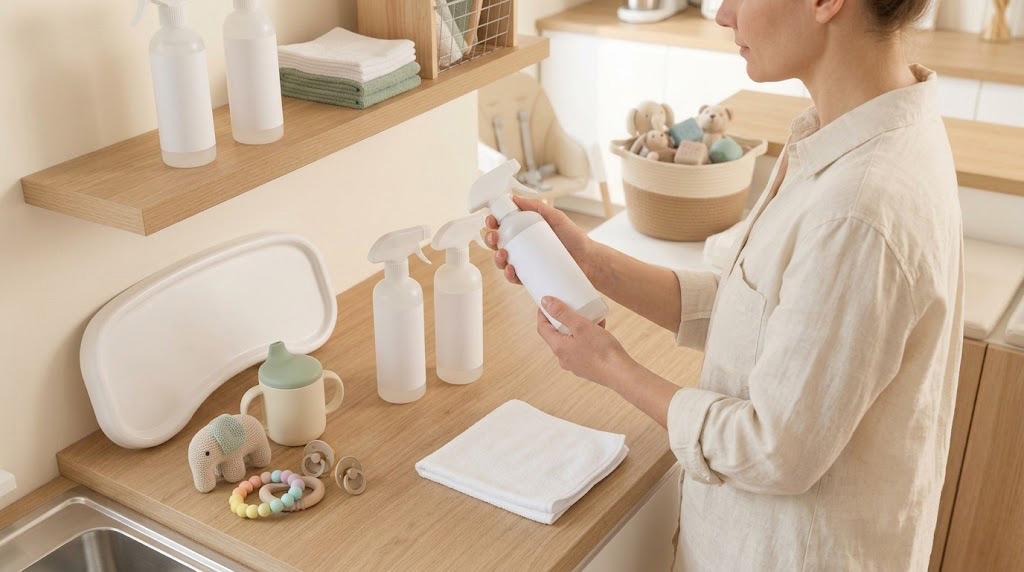
Baby-friendly surface sprays are designed for areas where feeding, play, diaper changes, and everyday household messes overlap. Parents and caregivers may use them on highchairs, toys, tables, changing areas, counters, floors, and other washable surfaces. The main challenge is choosing a product based on its actual function rather than relying only on words such as natural, gentle, or baby-safe.
The best baby-friendly disinfectant spray should state clearly that it sanitizes or disinfects, identify the surfaces it is intended for, and provide understandable usage directions. Ingredient transparency, fragrance preferences, residue information, food-contact guidance, and spray convenience also matter in a busy household.
Products in this category do not all perform the same task. Some use hypochlorous acid and make specific claims about killing viruses or bacteria, while others are all-purpose cleaners made mainly to remove food, grime, and fingerprints. These differences affect when and how each spray should be used.
This guide compares three products, identifies which option most closely matches disinfecting needs around baby-related surfaces, and explains cleaning versus disinfecting, ingredient checks, proper use, food-contact considerations, storage, and the buying factors that matter most.
Quick Comparison Table
| Product | Best For | Editor’s Rating | Price |
|---|---|---|---|
| CleanSmart Daily Surface Cleaner and Pet-Safe Disinfectant, 23 oz (2 pack) | Best for Daily Use: Multiple household surfaces | ★★★★★ | Check Latest Price |
| Dapple Baby All Purpose Cleaning Spray | Best for Everyday Messes: Food and sticky residue | ★★★★☆ | Check Latest Price |
| CleanSmart Nursery & High Chair Cleaner | Best Overall: Nursery and feeding surfaces | ★★★★★ | Check Latest Price |
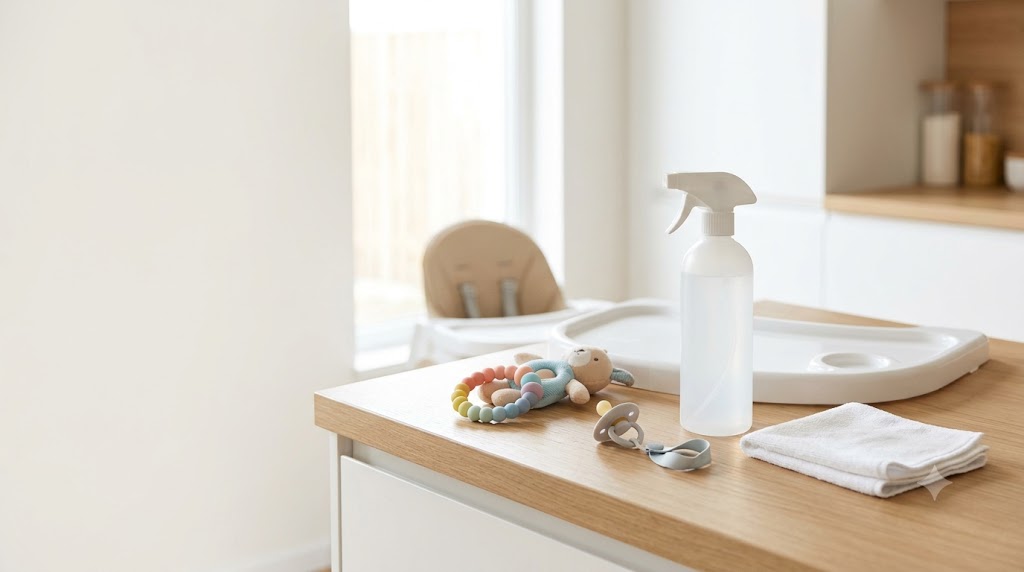
Best Baby Friendly Disinfectant Spray: 3 Picks
These products are intended for households that regularly clean or sanitize highchairs, toys, tables, changing areas, counters, floors, and other baby-contact surfaces. The available comparison criteria include stated product purpose, formula description, fragrance, residue claims, intended surfaces, food-contact guidance, and whether a disinfecting or sanitizing claim is supplied.
Different products suit different priorities. Two options are hypochlorous acid sprays with microorganism-killing claims, while one is an all-purpose cleaner for sticky messes and visible grime. Buyers should check the selected version, current label, package quantity, approved surfaces, and contact-time or rinsing directions before use.
1. CleanSmart Daily Surface Cleaner and Pet-Safe Disinfectant, 23 oz (2 pack)
Status:
Best for Daily Use
CleanSmart Daily Surface Cleaner is a ready-to-use hypochlorous acid spray intended for routine disinfecting across several household surfaces. It may suit families seeking one fragrance-free product for kitchens, play areas, floors, pet areas, and baby-related surfaces.
Product Snapshot:
- Best For: Daily disinfecting across multiple rooms and surface types
- Standout Factor: Broad stated use on counters, highchairs, toys, floors, and pet bowls
- Watch Point: Current contact-time and surface directions should be confirmed
The supplied information describes this product as a daily surface disinfectant that kills 99.9% of viruses and bacteria. This makes it relevant for households that want more than visible dirt removal and prefer a spray that can be used in several rooms.
Its listed surfaces include countertops, highchairs, toys, floors, pet bowls, and food-contact areas. That range may be useful for buyers who do not want separate bottles for the nursery, kitchen, and general household cleaning zones.
The formula is described as free from alcohol, ammonia, bleach, fragrance, and dyes. The brand also states that it breaks down into a saline solution after use and leaves no harsh residue. These claims should be checked against the current bottle label before treating food-contact surfaces.
The two-pack may be practical for placing one bottle in the kitchen and another near a nursery or play area. The supplied details do not confirm whether both bottles include separate spray triggers, so buyers should check the package contents.
Why It May Work:
- It is specifically described as killing 99.9% of viruses and bacteria.
- The listed surface range covers several common household cleaning areas.
- The formula is described as fragrance-free and without alcohol, ammonia, bleach, or dyes.
Possible Limits:
- Buyers should verify current wet contact time, pre-cleaning directions, and surface restrictions.
- The product is not specifically positioned around pacifiers and teethers in the supplied information.
Key Features:
- Hypochlorous acid formula
- Two 23-ounce bottles
- Non-abrasive surface spray
- Food-contact surface use stated
2. Dapple Baby All Purpose Cleaning Spray
Status:
Best for Everyday Messes
Dapple Baby All Purpose Cleaning Spray is a plant-based cleaner made for food residue, grime, fingerprints, and everyday messes on baby-contact surfaces. It may suit buyers whose main priority is frequent cleanup rather than disinfecting.
Product Snapshot:
- Best For: Cleaning sticky food and fingerprints from frequently used surfaces
- Standout Factor: Plant-based formula with an extensive ingredient exclusion list
- Watch Point: The supplied details describe cleaning, not disinfecting
This spray is presented as an all-purpose cleaner for highchairs, toys, swings, car seats, counters, and other household surfaces. Its stated purpose is lifting visible messes without leaving what the brand describes as harsh chemical residue.
The supplied information states that the formula is hypoallergenic, pediatrician tested, dermatologist tested, and made with plant-based ingredients. It is also identified as a Clean Label Project Purity Award winner. These statements do not guarantee that the formula will suit every sensitivity or surface.
The listed formula exclusions include parabens, sulfates, phthalates, mineral oil, synthetic dyes, synthetic fragrances, chlorine, alcohol, SLS, SLES, MEA, DEA, and TEA. The product is lightly fragranced with lavender essential oil, so it is not fragrance-free.
This package contains two 30-fluid-ounce bottles and one pump. The larger total volume may suit frequent mealtime cleanup, but buyers may need to move the pump between bottles unless they have another compatible sprayer.
Why It May Work:
- It is designed to remove sticky food, grime, and fingerprints.
- The supplied information provides detailed ingredient exclusions.
- The two-bottle package contains 60 fluid ounces in total.
Possible Limits:
- No disinfecting, sanitizing, or microorganism-killing claim was supplied.
- Lavender essential-oil fragrance may not suit buyers seeking an unscented cleaner.
Key Features:
- Two 30-fluid-ounce bottles
- One spray pump included
- Plant-based cleaning formula
- Lavender essential-oil scent
3. CleanSmart Nursery & High Chair Cleaner, Hypochlorous Acid, 23 oz (2 pack)
Status:
Best Overall
CleanSmart Nursery & High Chair Cleaner is a hypochlorous acid spray developed specifically around nursery, feeding, and baby-care surfaces. Its stated uses on highchairs, tables, teethers, pacifiers, sippy cups, changing tables, and diaper pails make it the closest match to the main keyword.
Product Snapshot:
- Best For: Sanitizing nursery, feeding, and frequently handled baby items
- Standout Factor: Specific stated use on pacifiers, teethers, sippy cups, and highchairs
- Watch Point: Current organism claims and contact-time directions should be verified
The supplied product information states that this spray sanitizes eating surfaces such as highchairs and tables and is food-surface-contact safe. It is also described as suitable for direct use on teethers, pacifiers, and sippy cups without rinsing.
Its hypochlorous acid formula is stated to kill 99.9% of viruses, including RSV and flu, as well as E. coli on changing tables and diaper pails. Buyers should verify the exact microorganism list, required wet contact time, and directions on the current product label.
The formula is described as free from gluten, alcohol, allergens, fragrance, and ammonia. The fragrance-free format may be useful in feeding and sleeping areas where scented sprays could be distracting or undesirable.
The supplied listing also states that hypochlorous acid is produced by the immune system and that the product is approved for use in neonatal intensive care units. Household buyers should not interpret this as medical advice or a guarantee of universal safety. The current label remains the primary source for home-use directions and precautions.
Why It May Work:
- It is specifically intended for nursery, feeding, and diaper-changing surfaces.
- The supplied directions include teethers, pacifiers, sippy cups, highchairs, and tables.
- The formula is described as fragrance-free and without alcohol or ammonia.
Possible Limits:
- Buyers should confirm current wet contact time and organism-specific directions before relying on disinfecting claims.
- The supplied information does not confirm whether the two-pack includes a separate sprayer for each bottle.
Key Features:
- Hypochlorous acid formula
- Two 23-ounce bottles
- No-rinse use stated for selected baby items
- Food-contact surface use stated
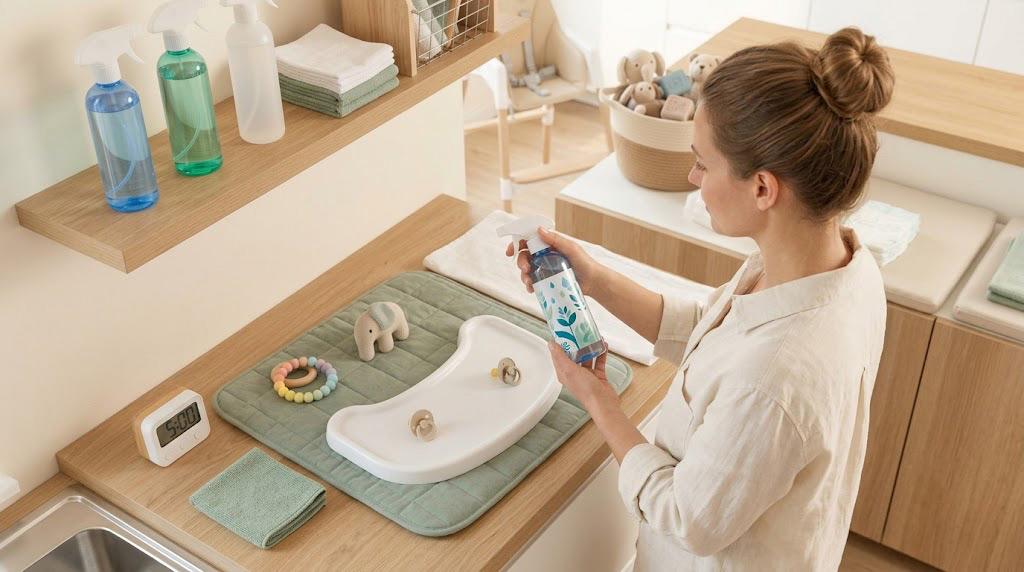
Best Baby Friendly Disinfectant Spray: What Really Matters First
The product recommendations show that the central buying challenge is identifying the job each spray is designed to perform. A product can be made for baby-related surfaces without being a disinfectant. Before choosing, decide whether you need routine cleaning, sanitizing, disinfecting, or a combination of separate products.
Formula and intended use shape everyday suitability. A nursery-focused hypochlorous spray may be more appropriate for pacifiers, highchairs, or changing areas, while a general household disinfectant may provide greater room-to-room flexibility. A plant-based all-purpose cleaner may be more useful for dried food and sticky residue.
The most important quality details are clear label claims, ingredient information, approved surfaces, food-contact guidance, and complete application directions. For disinfecting or sanitizing products, the surface may need to remain visibly wet for a specified period.
The wrong product type can create practical gaps. A cleaner may remove dirt without meeting a disinfecting goal, while a disinfectant may not remove heavy grime efficiently unless the surface is cleaned first. A nursery-focused formula may also be unnecessary for buyers who only need a general kitchen cleaner.
- Stated function: Confirm whether the product cleans, sanitizes, disinfects, or performs more than one task.
- Surface and item suitability: Check whether the label includes highchairs, toys, pacifiers, feeding items, or changing areas.
- Usage directions: Verify pre-cleaning, wet contact time, wiping, and rinsing requirements.
Key Buying Factors
| Factor | Why It Matters | What To Check |
|---|---|---|
| Product Purpose | Cleaning visible soil and reducing microorganisms are different tasks. | Look for a clear cleaning, sanitizing, or disinfecting statement. |
| Baby-Item Suitability | Products intended for counters may not automatically be suitable for pacifiers, teethers, or feeding items. | Confirm every planned item on the current label. |
| Ingredient Transparency | Clear formula information helps buyers compare fragrance and ingredient preferences. | Review the complete current ingredient list and exclusions. |
| Food-Contact Guidance | Highchairs, tables, and feeding items may require specific wiping or rinsing steps. | Check no-rinse claims and food-contact directions. |
| Application Directions | Sanitizing or disinfecting results depend on following the stated procedure. | Verify pre-cleaning, wet contact time, coverage, and wiping instructions. |
Buying Guide
The best option depends on where the spray will be used, whether visible messes or microorganisms are the main concern, and how closely the formula matches household preferences. A product intended for pacifiers and highchairs may be more relevant to some families than a broader all-purpose disinfectant.
This guide covers daily cleaning needs, formula and label quality, item compatibility, usage directions, storage, convenience, and common mistakes. These factors can also help determine whether one product is enough or whether a cleaner and disinfectant should be used for different tasks.
Match the Product to Daily Use
Start by listing the surfaces and items cleaned most often. Highchair trays and tables may collect food several times a day, while changing tables and diaper pails may call for a disinfecting routine based on the product directions.
Households that want one bottle for counters, floors, toys, and pet areas may prefer a general daily disinfectant. Families focused on pacifiers, teethers, sippy cups, highchairs, and nursery areas may find a baby-specific spray more practical.
An all-purpose cleaner can still be useful alongside a disinfectant. It may handle thick food residue and fingerprints before a disinfecting product is applied when needed.
- Feeding areas: Review food-contact and no-rinse directions.
- Nursery areas: Check claims for changing tables, diaper pails, and washable toys.
- General household use: Compare the stated surface range beyond baby items.
Check Label Transparency Before Claims
Words such as baby-friendly, natural, plant-based, hypoallergenic, and no residue provide useful context, but they do not explain the complete product function. The label should state whether the formula cleans, sanitizes, or disinfects and which surfaces or items are approved.
Ingredient exclusions can help buyers compare products, particularly when fragrance, alcohol, ammonia, bleach, dyes, or essential oils matter. A longer exclusion list does not automatically make a formula more suitable for every cleaning task.
Medical or institutional wording should also be read carefully. A statement about use in a clinical setting does not replace the household directions or guarantee that a product is appropriate for every person, item, or surface.
- Confirm the exact function: Look beyond broad front-label language.
- Read the full ingredient information: Formulas may change over time.
- Interpret approval claims carefully: Follow the current household-use label.
Review Ingredients and Usage Instructions
Before ordering, confirm that the formula is intended for every surface and item you plan to treat. Pacifiers, teethers, sippy cups, washable toys, fabrics, unfinished wood, electronics, and car-seat materials may have different care requirements.
For sanitizing or disinfecting, check whether visible residue must be removed first and how long the surface must remain wet. Spraying and immediately wiping may not satisfy the current directions.
Food-contact and baby-item instructions require particular attention. A no-rinse statement may apply only to specified surfaces or objects, so it should not be extended to every material.
- Confirm individual items: Do not assume a general surface claim includes pacifiers or teethers.
- Follow contact-time directions: Keep the surface wet for the stated period.
- Review rinsing instructions: Check whether wiping or rinsing is required after treatment.
Think About Daily Convenience
A suitable formula can still become inconvenient if it is stored far from where messes happen or if a multi-bottle package includes only one spray pump. Check bottle count, volume, included sprayers, and whether bottles can be placed in separate cleaning areas.
Fragrance affects routine comfort. Fragrance-free sprays may work well near food and sleeping areas, while a light essential-oil scent may appeal to buyers who prefer a noticeable cleaning fragrance.
Labels should remain attached and readable throughout use. They provide the application directions, surface list, ingredient information, and storage precautions needed for safe handling.
- Package setup: Confirm whether each bottle includes its own trigger.
- Scent preference: Distinguish fragrance-free formulas from essential-oil fragrance.
- Storage access: Keep sprays convenient for adults but inaccessible to children.
Avoid These Buying Mistakes
A common mistake is assuming that every baby cleaning spray disinfects. Nursery branding may indicate intended use, but only a clear sanitizing or disinfecting claim confirms that the product is made for reducing stated microorganisms.
Another mistake is assuming that all hypochlorous acid sprays have identical directions or approved uses. Product versions may differ in their listed surfaces, organisms, contact times, and no-rinse instructions.
Buyers should also avoid treating an ingredient exclusion list as a substitute for function. A formula can be plant-based and suitable for grime removal without replacing a disinfectant.
- Do not confuse cleaning and disinfecting: Match the product to the intended task.
- Do not combine directions between products: Follow the selected bottle’s current label.
- Do not overlook version details: Check size, bottle count, fragrance, and included sprayers.
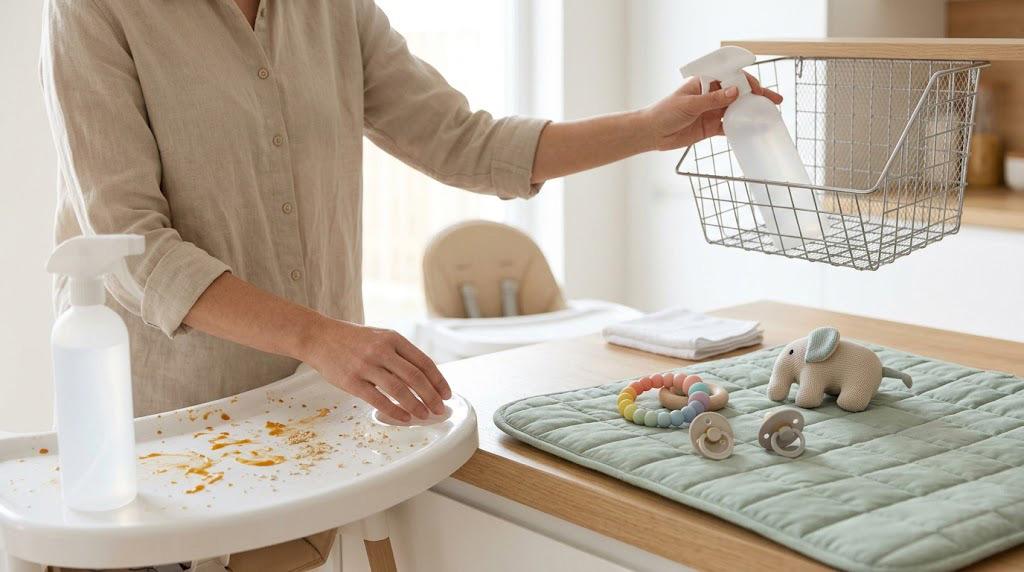
Cleaning, Sanitizing, and Disinfecting Are Not the Same
Cleaning removes food, grease, dirt, fingerprints, and other visible residue. This is often the first step when a highchair tray, toy, table, or changing surface is visibly soiled.
Sanitizing and disinfecting involve reducing stated microorganisms according to the product label. The exact claim, organisms, application method, and contact time can differ between formulas.
This distinction explains why Dapple and the two CleanSmart products are not direct substitutes. Dapple is described as an all-purpose cleaner, while the CleanSmart sprays make sanitizing or disinfecting claims.
- Use a cleaner when the immediate problem is visible grime.
- Choose a sanitizing or disinfecting product when microorganism reduction is the goal.
- Follow the current product directions rather than assuming all sprays work identically.
How to Use Baby-Friendly Surface Sprays
Begin by checking both the product directions and the care instructions for the surface or baby item. Remove crumbs, food, dirt, and heavy residue when required.
Apply the spray according to the current label. For a sanitizer or disinfectant, use enough product to cover the surface and meet the stated wet contact time. Do not shorten this period unless the instructions allow it.
Complete any required wiping, rinsing, or drying steps before returning the item to a baby. No-rinse wording should be applied only to the items and surfaces confirmed by the selected label.
- Treat only the surfaces and items listed in the directions.
- Follow stated pre-cleaning and wet contact-time requirements.
- Keep the product away from a baby during application and drying.
Safety and Usage Considerations
No household cleaner or disinfectant should be described as completely safe for every person, item, or situation. Use each spray only as directed and avoid unnecessary airborne application.
Do not mix cleaning products. Different formulas can react unpredictably, and mixing is not needed for routine use.
Fragrance-free and hypoallergenic claims describe different features. Fragrance-free products may suit buyers who avoid scent, while hypoallergenic wording does not guarantee that no sensitivity will occur.
- Keep every spray out of children’s reach.
- Maintain ventilation according to the current directions.
- Stop using the product on a surface if compatibility is unclear.
How to Store Surface Sprays
Keep each spray in its original container with the current label intact. Moving the liquid into an unmarked bottle can make it difficult to identify the formula or follow the correct directions.
Close the bottle securely and store it upright. Place it where adults can reach it without leaving it accessible to babies or children.
Check the product label for any specific storage restrictions. Avoid using a leaking, damaged, or unidentifiable container.
- Store products in their original labeled bottles.
- Keep bottles upright with triggers or caps secured.
- Place all cleaning products outside children’s reach.
Final Recommendation
CleanSmart Nursery & High Chair Cleaner is the best overall choice for the main keyword because its supplied information focuses directly on highchairs, feeding surfaces, pacifiers, teethers, sippy cups, changing tables, and diaper pails. Its hypochlorous acid formula, fragrance-free positioning, food-contact guidance, and specific nursery use make it the closest match for buyers seeking a baby-focused disinfecting or sanitizing spray.
CleanSmart Daily Surface Cleaner is the stronger alternative for households wanting a broader product for floors, counters, pet bowls, toys, and general daily surface disinfecting. Dapple Baby All Purpose Cleaning Spray is better suited to removing sticky food, grime, and fingerprints, but the supplied information does not identify it as a disinfectant.
Common Questions About Best Baby Friendly Disinfectant Spray
Is a baby cleaning spray automatically a disinfectant?
No. A baby-focused cleaner may remove food, grime, and fingerprints without making a sanitizing or disinfecting claim. Check the product’s stated purpose rather than relying only on its name or plant-based positioning.
Which reviewed product is most specifically designed for nursery use?
CleanSmart Nursery & High Chair Cleaner is the most nursery-focused option in this comparison. Its supplied uses include highchairs, tables, teethers, pacifiers, sippy cups, changing tables, and diaper pails.
What is the difference between the two CleanSmart sprays?
Both are described as hypochlorous acid products that kill 99.9% of viruses and bacteria. The Daily Surface Cleaner has a broader household surface focus, including floors, counters, toys, food-contact areas, and pet bowls.
The Nursery & High Chair Cleaner is positioned more specifically for feeding items, highchairs, changing areas, pacifiers, teethers, and sippy cups. Buyers should compare the current labels because contact times and approved uses may differ.
Do I need a separate cleaner and disinfectant?
Possibly. A cleaner is useful for lifting sticky food, grease, dirt, and fingerprints. A disinfectant or sanitizer is used according to its label to reduce stated microorganisms.
A household dealing with frequent food messes may prefer an all-purpose cleaner for routine wiping and a separate disinfecting product for situations that require it.
Can baby-friendly disinfectant sprays be used on pacifiers and teethers?
Only when the current label specifically confirms those items. The supplied information for CleanSmart Nursery & High Chair Cleaner states that it can be sprayed on teethers and pacifiers without rinsing, but buyers should verify that instruction on the current bottle.
Does fragrance-free mean hypoallergenic?
No. Fragrance-free describes the absence of added fragrance according to the product information. Hypoallergenic is a separate claim and does not guarantee that every person will avoid sensitivity.
CleanSmart’s supplied information describes both hypochlorous products as fragrance-free. Dapple is described as hypoallergenic but contains lavender essential oil.